Most people know the basic pitch on indica vs. sativa vs. hybrid: indica is relaxing, sativa is energizing, and hybrid sits somewhere in the middle.
Simple enough. Except there’s one small problem: almost everything on a modern dispensary menu is technically a hybrid.
That doesn’t make the labels useless. They’re still a helpful first filter when you’re staring at a menu with 40 strains and wondering where to start.
But “hybrid” by itself doesn’t tell you much.
The more useful questions are: Which way does it lean? What does “dominant” actually mean? And how much can you really tell from that label?
Let’s get into it.
Indica vs. Sativa vs. Hybrid: Understanding the Genetics
Before we get into the different kinds of hybrids, it helps to understand the two traditional categories they came from.
Pure Indica
Pure indica genetics trace back to landrace varieties from mountainous, cooler regions such as the Hindu Kush range spanning Afghanistan and Pakistan.
The plants adapted to those conditions. They tend to be shorter and bushier, with a relatively fast flowering period — often around 7 to 8 weeks.
Hindu Kush and Afghani are well-known examples of landrace indica genetics. They’ve also become foundational genetics for countless hybrids bred since.
But here’s the catch: truly pure indica is uncommon on a modern dispensary menu.
Most products labeled “indica” today are actually indica-dominant hybrids. Decades of breeding have mixed different genetic lines to develop plants with traits growers and consumers want.
So if you’re expecting a menu full of untouched landrace indicas, you may be waiting a while.
Pure Sativa
Pure sativa genetics come from landrace varieties adapted to warmer, equatorial regions, including places such as Thailand, Colombia, and parts of Central Africa.
The plants developed differently from their indica counterparts. They’re generally taller, with narrower leaves and a much longer flowering period — often 11 to 14 weeks or more, depending on the genetics.
Thai and Panama Red are well-known examples of landrace sativa genetics, with histories that go back long before today’s hybrid-heavy market.
That long flowering time is one reason pure sativa became less common commercially.
For a grower, waiting three months or longer for a plant to finish isn’t exactly the fastest route to harvest. So breeders began crossing sativa genetics with faster-flowering indica lines, bringing some of those sativa characteristics into plants that could finish sooner.
The result?
More hybrids. Fewer truly pure sativas.
Where Hybrids Fit In
And this is where the modern menu starts to make more sense.
Nearly every hybrid you see today — indica-dominant, sativa-dominant, or balanced — has a genetic history that runs through landrace varieties like these and the generations of breeding that followed.
That’s important because “dominant” doesn’t mean a plant is simply half one thing and half another. It means the hybrid leans toward one side of that genetic lineage.
Once you understand that, those three little words on the menu — indica, sativa, hybrid — become a lot more useful.
Where the Labels Come From
How a Hybrid Gets Made
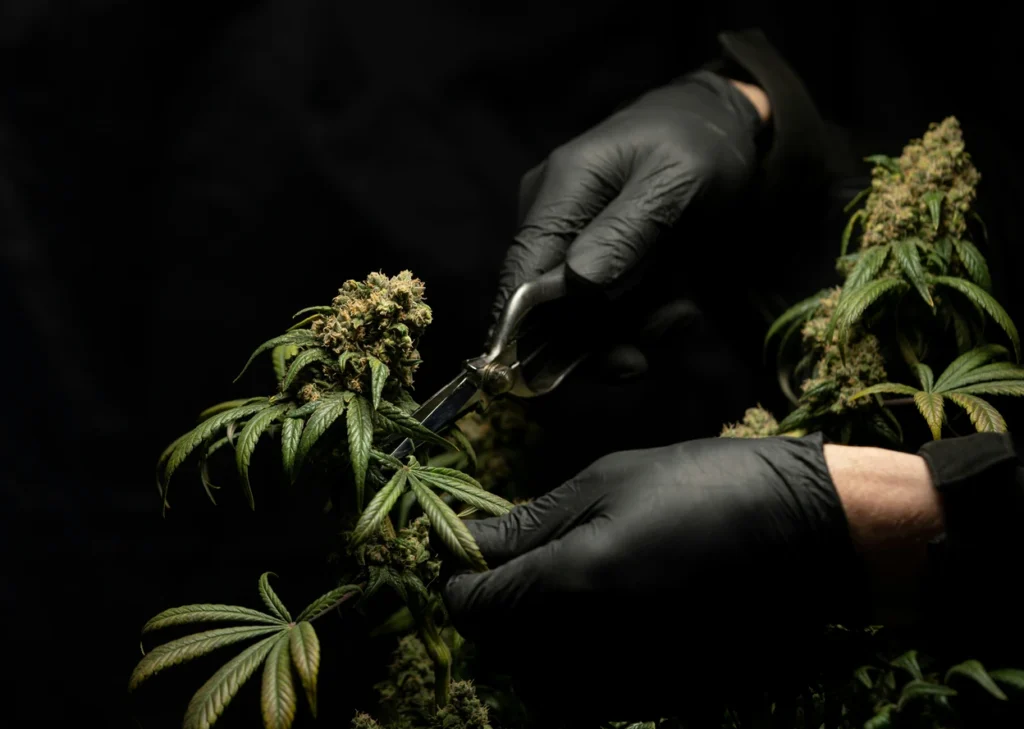
A hybrid starts with breeders crossing two different cannabis varieties. Usually, each parent brings something the breeder wants to keep — maybe a particular aroma, growth pattern, flowering time, yield, or cannabinoid and terpene profile.
The first cross is called an F1, or first-generation hybrid.
Because those genetics are being combined for the first time, F1 plants can vary quite a bit from one seed to another.
Same parents. Different offspring. Cannabis genetics like to keep things interesting.
Getting to a Stable Strain
From there, breeders can work through additional generations to make certain traits more consistent.
- Backcrossing — crossing a hybrid back with one of its original parent plants
- Repeating the process — reinforcing the traits the breeder wants across generations
- Stabilizing the variety — producing plants that are more predictable from seed to seed or clone to clone
The goal is consistency.
If a breeder finds a combination of traits worth keeping, the next step is figuring out how to reliably reproduce it.
What “Dominant” Actually Means
When you see indica-dominant, sativa-dominant, or balanced, you’re looking at a description of the plant’s genetic lineage, not a precise recipe.
- ~70% indica / 30% sativa genetics → generally described as indica-dominant
- ~70% sativa / 30% indica genetics → generally described as sativa-dominant
- Closer to a 50/50 split → generally described as balanced
The important word there is roughly.
Cannabis breeding isn’t a neat pie chart where every percentage is universally measured the same way. Different breeders can classify genetics differently, so these labels are best treated as useful shorthand rather than a scientific scorecard.
Think direction, not exact math.
Why Two Plants of the “Same” Strain Can Still Be Different
Here’s where cannabis genetics gets a little more interesting.
Two plants can share the same strain name and still turn out differently. That’s called phenotype variation — basically, differences in how a plant’s genetics show up as it grows.
Genetics are one part of the equation. The environment is another. Growing conditions can influence things like plant structure, aroma, and cannabinoid and terpene expression. That means two plants from the same genetic line can end up looking or smelling a little different.
Growers who grow multiple plants looking for a particularly standout version of a strain are doing what’s called pheno hunting.
Find a standout plant? A grower may preserve that particular phenotype through cloning.
And this is why indica-dominant doesn’t mean every batch will be identical. The label describes a genetic tendency. It doesn’t guarantee that every harvest will look, smell, or feel exactly the same.
The strain name is the starting point. The specific genetics, growing conditions, harvest, and individual batch fill in the rest.
The Three Hybrid Types
Now we can get to the part that actually matters when you’re looking at the menu.
Indica-Dominant Hybrids
Indica-dominant hybrids lean toward genetics traditionally associated with indica.
On a dispensary menu, indica-dominant is commonly used as shorthand for a more relaxing, body-forward experience.
Useful? Absolutely.
A guarantee? Not quite.
The actual experience can vary from strain to strain depending on the genetics, cannabinoid profile, terpene profile, and individual product.
If you’re browsing for something suited to a slower-paced evening, indica-dominant is one category worth starting with.
Sativa-Dominant Hybrids
Sativa-dominant hybrids lean toward genetics traditionally associated with sativa.
On the menu, sativa-dominant is commonly used as shorthand for a more uplifting or energetic experience.
Same rule applies: useful signal, not a promise.
If you’re shopping for something to fit a daytime plan, a social setting, or you simply want to explore the more energetic side of the menu, sativa-dominant is a natural place to start.
Balanced Hybrids
Balanced hybrids sit closer to the middle of the spectrum, combining genetics associated with both sides without a strong lean toward either one.
That doesn’t mean every balanced hybrid will feel the same.
Two varieties with a similar genetic split can have very different cannabinoid and terpene profiles. One might lean toward characteristics traditionally associated with indica, while another may lean toward those associated with sativa.
So balanced doesn’t mean predictable.
It simply means the genetics don’t have a strong dominant lean.
A Note on Product Format
There’s another wrinkle: the same strain label doesn’t tell you the whole story across every product type.
This framework is easiest to apply to flower and vapes, where the strain, genetics, and terpene profile are usually front and center.
Edibles are a different conversation.
With an edible, factors such as THC dosage, cannabinoid content, the specific formulation, and individual differences become especially important. The strain lineage may still be listed, but it’s not something to use as your only guide.
Shopping for gummies?
Check the milligrams first.
The indica or sativa label is a much softer signal here.
Reading the Ratio on a New Jersey Label
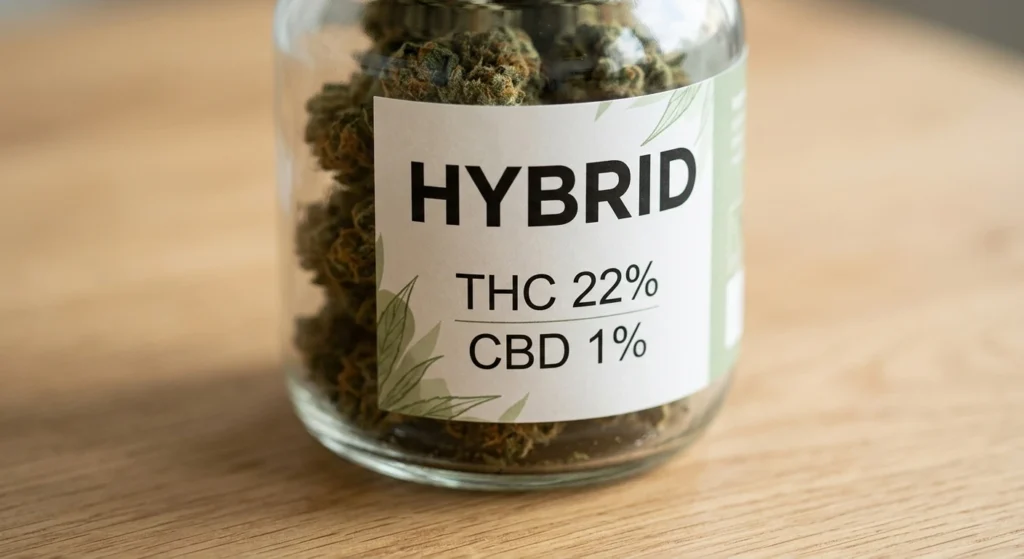
Cannabis products sold through the regulated market are tested by licensed third-party laboratories before reaching dispensary shelves. The results are documented in a Certificate of Analysis, or COA.
The indica/sativa/hybrid classification is one piece of information. The product’s chemotype is another.
New Jersey products can be classified by their THC-to-CBD ratio:
- High THC, Low CBD — ratio greater than 5:1, with total THC at 15% or higher
- Moderate THC, Moderate CBD — ratio between 5:1 and 1:5, with total THC between 5% and 15%
- Low THC, High CBD — ratio less than 1:5, with total THC at 5% or lower
These labels are telling you different things.
The indica/sativa/hybrid label is about genetic lineage and the traditional classification used on dispensary menus.
The chemotype tells you about the product’s cannabinoid profile, specifically THC relative to CBD.
So an indica-dominant hybrid and a sativa-dominant hybrid could both be classified as high THC, low CBD. That’s why checking both gives you more information than relying on either label alone.
And if you want the full lab breakdown, including the cannabinoid and terpene results, that’s where the COA comes in. And this framework isn’t limited to high-THC products. CBD-forward hybrids can still have indica-dominant or sativa-dominant genetics.
The two classifications are independent. One doesn’t determine the other.
Is the Indica/Sativa Split Even Real Anymore?
If you’ve spent any time in cannabis forums, Reddit threads, or dispensary conversations, you’ve probably seen this debate: after decades of crossbreeding, does the indica/sativa split actually mean much anymore?
There’s a good reason people question it. A 2021 study published in Nature Plants looked at 297 cannabis samples and found no clear genetic difference between plants labeled Indica and Sativa.
Basically, when researchers looked at the plants’ DNA, the labels didn’t neatly match up with their genetics. Some terpenes did line up with the labels, including myrcene and a few others, but the overall picture was much messier.
That’s the important part: indica and sativa aren’t completely made up. They’re just not as simple as the labels make them sound. Modern cannabis has been crossed and bred so much that most strains don’t fit neatly into one genetic box.
The Bottom Line
Is the indica/sativa split real? Kind of, just not in the simple way you might think. The labels can give you a general idea of a strain’s lineage, but they don’t tell you exactly what’s in the product or how it’ll smell or feel.
The names stuck. The genetics got complicated.
How to Use This When You’re Shopping
Start with what you’re looking for.
A slower-paced evening? Indica-dominant is one place to start.
A daytime or social plan? Sativa-dominant is another.
Want something that doesn’t lean hard either way? Try balanced.
Then go one step further: check the THC and CBD numbers, look at the terpene profile when it’s listed, and ask for the COA if you want the complete lab breakdown.
Think of indica, sativa, and hybrid as the first filter, not the final answer.
You don’t need to memorize any of this before you walk into Theo in Franklin Park, NJ. Bring us the vibe you’re going for, and we’ll help you land on a strain, format, and lean that actually fits it, no genetics lecture required. Browse our hybrid selection to see what’s on the shelf right now, or check our deals page if you want to stock up while saving a little.
Must be 21+ to purchase. Please consume responsibly and in accordance with New Jersey law.